
Reports Report 5833p (Event 5833-2025)
| Observer | |
|---|---|
| Name | Douglas M |
| Experience Level | 2/5 |
| Remarks | - |
| Photo |
|---|
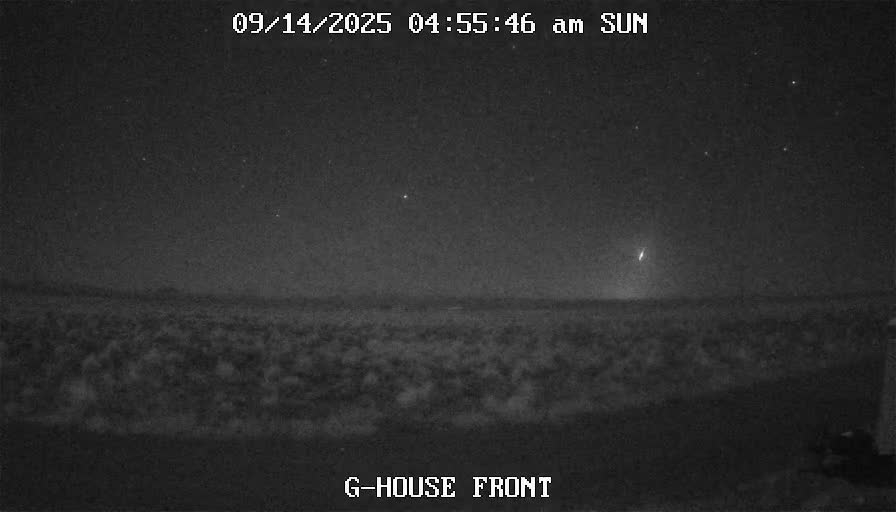
|
| Location | |
|---|---|
| Address | Blanca, CO |
| Latitude | 37° 20' 55.98'' N (37.348884°) |
| Longitude | 105° 32' 52.96'' W (-105.548044°) |
| Elevation | 2348.836914m |
| Time and Duration | |
|---|---|
| Local Date & Time | 2025-09-14 04:55 MDT |
| UT Date & Time | 2025-09-14 10:55 UT |
| Duration | ≈3.5s |
| Direction | |
|---|---|
| Moving direction | From up right to down left |
| Descent Angle | 210° |
| Moving | |
|---|---|
| Facing azimuth | 262° |
| First azimuth | 268° |
| First elevation | 25° |
| Last azimuth | 262° |
| Last elevation | 18° |
| Brightness and color | |
|---|---|
| Stellar Magnitude | -27 |
| Color | White |
| Concurrent Sound | |
|---|---|
| Observation | No |
| Remarks | - |
| Delayed Sound | |
|---|---|
| Observation | No |
| Remarks | - |
| Persistent train | |
|---|---|
| Observation | No |
| Duration | - |
| Length | - |
| Remarks | - |
| Terminal flash | |
|---|---|
| Observation | Yes |
| Remarks | Angular Size: A 0.7-1.3 degree flash suggests a bright fireball (-6 to -8 magnitude) at a moderate altitude. For reference, the moon is 0.5 degrees, so this was 1.4-2.6 times wider, implying a large, fragmenting meteoroid. Altitude: Most fireballs visible as flashes peak at 20-40 km (12-25 miles) up, with the burst often lower (10-20 km) if it fragmented early. Chi Cygnids, being slow (15-33 km/s), tend to burn lower than fast meteors like Perseids. Direction: West of Blanca (Sangre de Cristo range horizon), the flash’s low angle suggests it was either close and low or farther and higher. Your cam caught the fade, so it likely traveled west-to-east or descended toward you. Brightness and Visibility: A -6 to -8 magnitude flash visible 50-150 miles is typical for bolides this bright, per AMS data on past events (e.g., 2019 Colorado fireball seen 100 miles). |
| Fragmentation | |
|---|---|
| Observation | Yes |
| Remarks | Just the streak in the photo then it disipated... Was on an IR Security Camera. |