 American Meteor Society

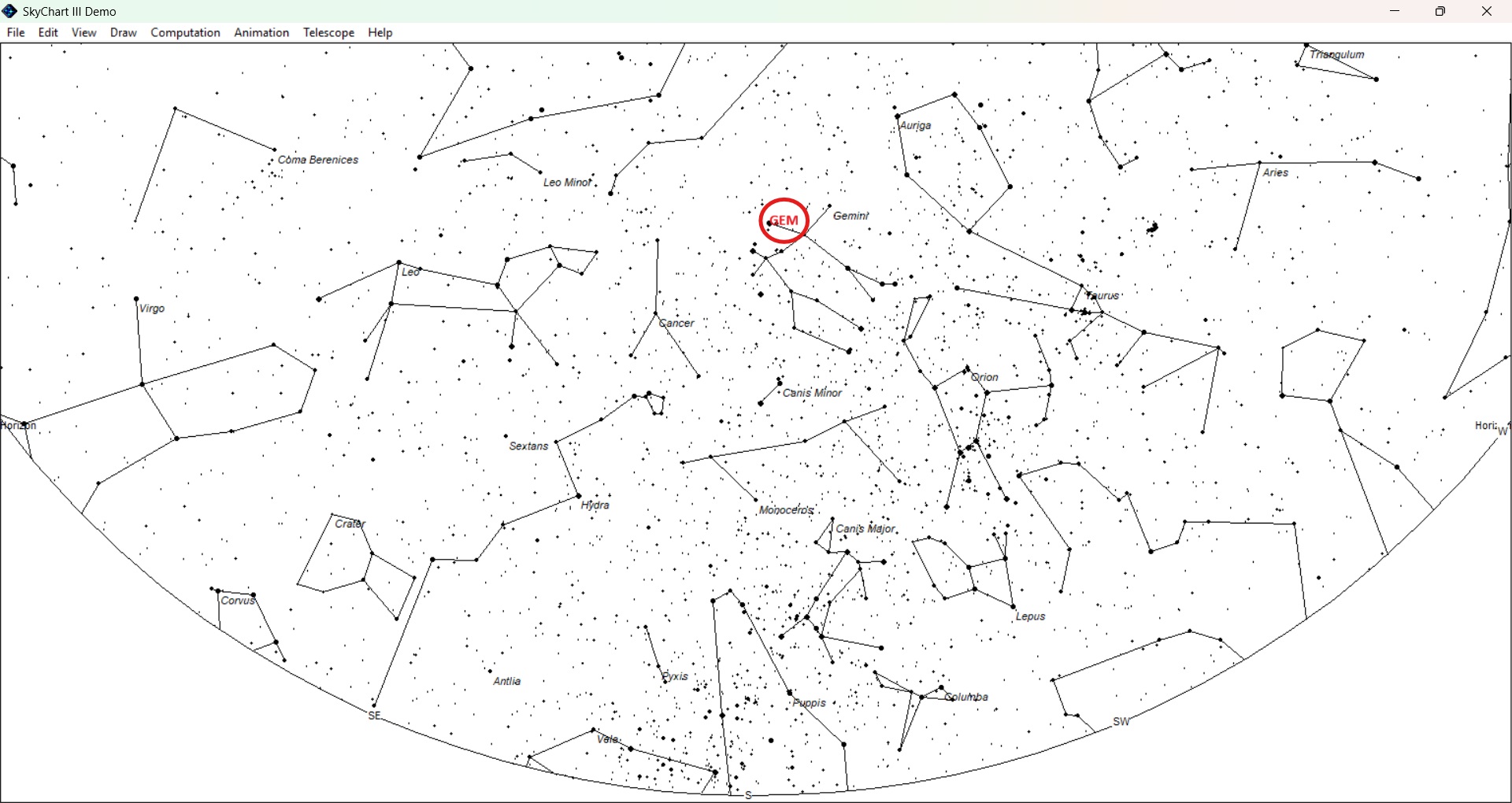
Peter Slansky created this composite photo from Geminid activity captured during the 2020 display. Note that the streaks all diverge from an area near the star known as Castor (alpha Geminorum). Also note how the length of each path becomes longer the further they appear from the Geminid radiant.
The Geminid meteor shower is produced by debris from the “comet/asteroid” known as 3200 Phaethon. The earth encounters these particles from December 1 through the 21st, passing closest to the core on the night of December 13/14. The Geminids were first noted in 1862, when hourly rates were much lower than those observed today. Activity from this shower increased during the remainder of the 19th century and throughout the 20th century, perhaps peaking near the year 2000. Hourly rates during the first quarter of the 21st century have been slightly less than those seen near the beginning of the century, but this display is still far and away the strongest and most reliable annual meteor of the year. It is possible that the display has not weakened at all, but that the spread of nighttime light pollution has spread further than before, reducing the number of meteors visible to the naked eye.
Conditions for viewing the maximum activity for this display in 2025 are favorable despite a 25 percent crescent moon rising near the time of the nightly maximum activity (2am local standard time). There are three main strategies for viewing this display in 2025. These strategies are based on viewing either on Saturday evening December 13th or the morning of the 14th or a combination of both. For those who cannot few into the morning hours one can watch as soon as it becomes dark. At that time The Geminid radiant will lie near the east northeastern horizon and rates will be at the lowest point of the night. The few meteors that do appear at this time are special in the fact that they just skim the atmosphere rather than penetrate deeply. This allows them to last for several seconds rather than the normal sub-second duration. Their visible length in the sky is also much longer than the normal sub-ten-degree length of your normal meteor. During the first hour of the night only 5 or so of these meteors will be seen, but they are certainly more impressive than your normal Geminid meteor. As the evening progresses the Geminid radiant rises higher into the eastern sky and more meteors will appear. These meteors will become quicker and shorter as the night progresses. To best see Geminid meteors at this time face eastward and expect most of the long earthgrazers to appear low in the northern and southern sky, shooting toward the west.
The second strategy would be to wait to observe until 10pm, when the Geminid activity begins to pick up. Under a dark rural sky, up to 30 Geminid meteors can be seen at this time. The Geminid radiant will be located half-way up in the eastern sky and the meteor activity can be seen shooting in all directions. It would still be best to face toward the eastern half of the sky to see the most activity. Conditions will remain dark until moonrise at 2am. As each hour passes, hourly rates will increase reaching maximum near 2am. At this hour expect to see up to 60 Geminid meteors from dark rural sites.
The last option would be to observe from roughly midnight to 4am. During this period one would see the most activity as long as you keep the rising moon out of your field of view. Midnight to 2am will be the prime time as rates will begin to fall once the moon has risen and the Geminid radiant begins to set into the western half of the sky.
If it appears that the night of December 13/14 will be cloudy, plan to observe prior to maximum. Geminid rates will be roughly 75 percent of maximum on the night of the 12/13 and 50 percent of maximum on the 11/12. It should also be noted that the moon will rise an hour earlier on each preceding night and will also have an increased phase of 10 percent per night.
I personally prefer option #2 and will be observing from 10pm to 2am on the nights of December 11/12, 12/13, and 13/14. When the moon rises on the first two nights, I will simply shift my view more toward the west to avoid looking directly at the moonlight. While the night of December 14/15 is only one day after the maximum activity, hourly rates will have fallen by at least 50 percent during that night. Of course, if cloudy skies disrupt this schedule, I may observe past the night of maximum.
Satisfactory views of this display can be obtained from well-lit suburban skies, but hourly rates will be less than half those seen from darker skies. If you are serious about seeing the most meteor activity, view from the darkest location possible. I also advise observers to watch for as long as possible. The main reason for this is that material in space is not evenly spread. There will be periods of time when little activity is seen and other times when it seems that an outburst is occurring. The longer you watch, the odds are that you will be able to enjoy periods of higher activity. Whatever you do, don’t stand and try to see this activity. Use a comfortable lounge chair and angle it so that you are looking half-way up in the sky. If there are obstacles such as trees or hills blocking your view, then aim your view a little bit higher so that these obstacles lie just below your field of view. Most meteor activity will be seen in the lower half in the sky and viewing straight up is the least likely direction to see meteor activity.
Most folks watch meteor showers for sheer enjoyment, like one would view a fireworks display. But inspired people can actually contribute to our knowledge of these displays by counting the number of meteors they see during a set period of time. Crazy people like me record the shower association, time, magnitude, duration, length, and elevation of each meteor I see. Of course, I use a digital voice recorder so I can keep my eyes on the sky. I fill in the report forms the next day after catching up on sleep. The last three items are not required but helps me determine shower association with more certainty The most important thing not listed above is viewing conditions, which is basically the faintest star you can see and any cloud obscuration. This is easily done by counting the number of stars visible in a small area of the sky. More information on recording meteors is available at: Visual Observations and Limiting Magnitude.
I would be interested in any data you record by either direct email or commenting on this article online. Don’t miss this opportunity to view the best meteor shower of the year, especially since it peaks on a weekend under favorable conditions. I wish everyone clear skies!

At 3:30PM on December 9th, 2025 while inside my house in Central Massachusetts I heard a long sonic boom. It sounded similar to a plane crash with a full fuel tank or a jet breaking the sound barrier. As a child back in the early 60’s I heard a lot of sonic booms so it sounded most similar to that, just longer. I posted on the local Facebook page to ask if anyone else heard it. I have reports from as far away as the south end of town and from the town north of us. So we ruled out transformer or electrical explosions. It was heard from too far away for it to be trees being felled or dynamite explosions for construction. There were no reports of earthquake activity. Since the sound came from overhead it appears that it was most likely a meteor and no one saw it because it was still daylight. Hopefully, this information will be useful to you.
Great viewing tips and info, Robert, thanks! With the Geminids on peak night, I prefer options 1, 2, and 3… or as long as the coffee or tea keeps me alert enough, lol. And you’re so spot on about using a digital voice recorder to note details – other than taking breaks for drinks or snacks, time spent writing out notes certainly guarantees I’ve often missed some of the best meteors! Unfortunately here, clouds being forecast locally both Fri and Sat nights may ruin the opportunity, so… Hope you have better luck, thanks again and happy viewing!
I began observations under an excellent dark sky at 1:17 AM local time. I abandoned my viewing session after just 15 minutes because I had seen only 3 Geminids. I’m 75 years old, so my eyes aren’t very good. However, I’ve been observing meteors for 60 years and have learned the techniques for seeing the most meteors.
I did not view the Geminids visually; instead, on December 13, 2025 evening, from 6:22 to 11:38 pm MST here in Colorado Springs, I used the PSK144 mode on “WSJT-X” open-source software and my Yaesu FT-710 HF radio transceiver transmitting at 100W coupled with a Diamond CP-6A multi-band vertical antenna, and setup a separate folder for all the sound files that I captured during that time. At about 11:15 pm, I started to hear several strange high-frequency “buzzes” during the reception time period. Those were meteors.