 American Meteor Society
Yesterday I spent the day working with Claude AI (Opus 4.5) to dig into the AMS fireball database going back to 2011. The goal was to answer the question everyone’s been asking: is fireball activity actually up, or does it just feel that way?
The short answer: yes, it’s up — and the data tells us something interesting about why.
The number of large fireball events (those seen by 50+ witnesses) has roughly doubled in Q1 2026 compared to the five-year average. But the total number of fireballs is about normal. So it’s not that more rocks are hitting us — it’s that more of them are big enough to notice.
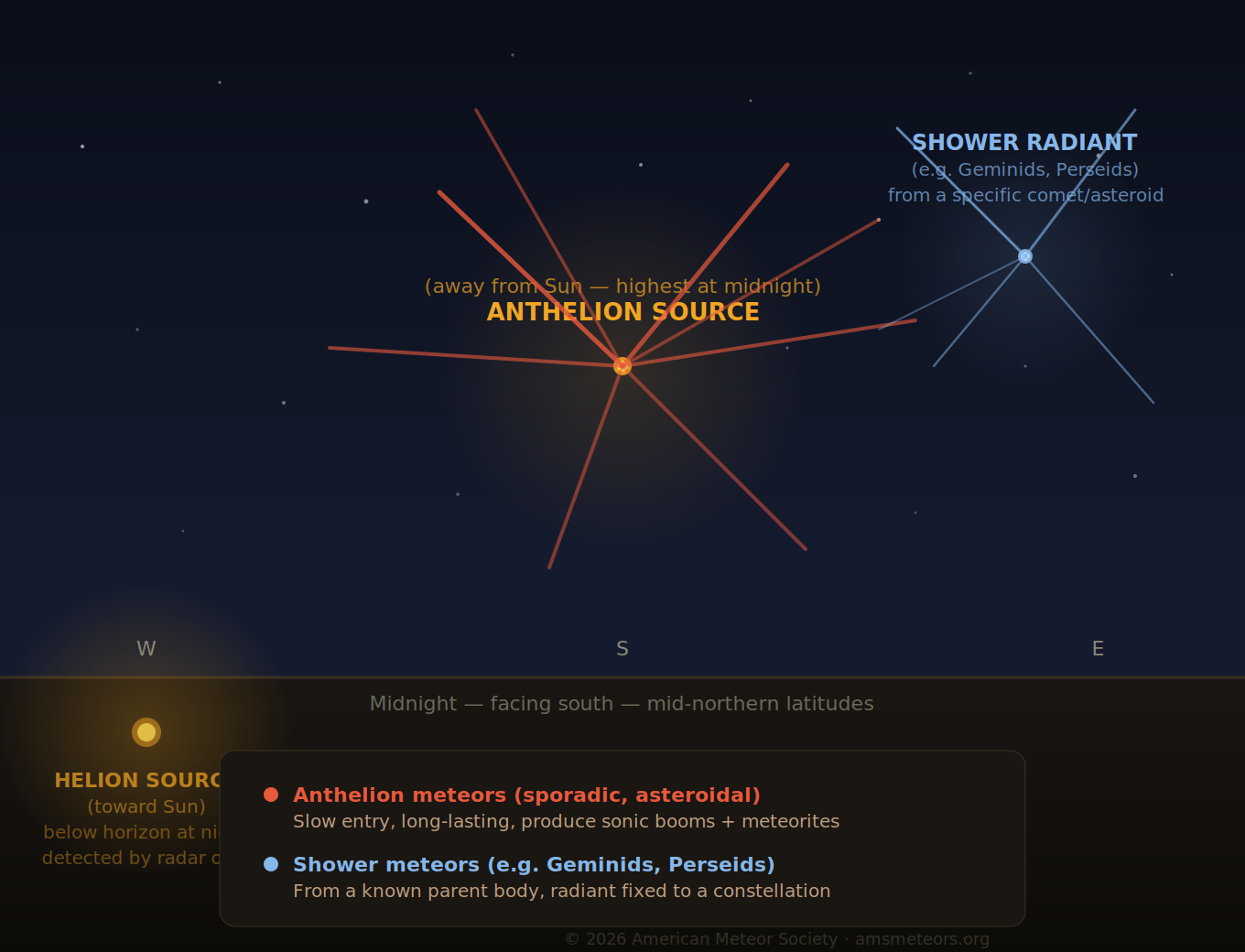
Anthelion, Helion and Meteor Shower Radiant Sources
Our radiant analysis shows the increase is concentrated around the Anthelion source — the region of sky directly opposite the Sun. These are asteroidal objects on orbits similar to Earth’s, moving in the same direction we are. When they encounter Earth, our orbital velocity is effectively subtracted from theirs, so they enter the atmosphere at relatively low speeds. Slower entry means the meteor lasts longer in the sky, is visible over a wider area, produces sonic booms more often, and more material survives to reach the ground as meteorites. That’s exactly what we’ve been seeing — including two rare HED achondrite falls (Germany and Ohio) in just nine days.
We’ve published a full data-driven analysis with interactive charts, computed radiants for 255 events, and a downloadable dataset for anyone who wants to check our work:
👉 2026 Q1 Fireball Analysis
As always — if you see a fireball, report it at https://fireball.amsmeteors.org. Every report matters.
Mike Hankey – AMS Operations Manager

Thank you for clarifying
So any ideas of what is causing this? Lots of fear mongering going around online right now. Claims that “the big one” (asteroid) is coming, and other wild claims.
Jack and All,
As the article says, we are seeing a normal number of fireballs. What is unusual is the fact that several of these fireballs are larger than normal, therefore easier to observe by a larger number of witnesses. These larger meteors are still only 1-2 yards in size prior to encountering the atmosphere, certainly nothing to threaten the Earth or its inhabitants. The resulting meteorites on the ground are no larger than a few inches in size.
Understood. So what could be causing this change in size? Natural variation?
GEOS East and West GLM sensor data bolide detections have surged since mid-2019. See, https://neo-bolide.ndc.nasa.gov/
Yes most likely a natural ebb and flow. There’s lots of stuff floating around in space and it is not all a uniform size. Sporadic meteors are different and unpredictable by definition. They can vary not only in time, but also size.
Skeletor says what?
Big picture dude. Space. Galaxy. Universe.
That’s what is causing it.
Nasa just released an article on March 26, 2026 5:18PM, stating that the increase in fireballs is likely due to fireball season, contradicting whats stated in your article. Any thoughts? (https://www.nasa.gov/blogs/watch-the-skies/2026/03/26/its-fireball-season-answering-your-meteor-questions/)
IMHO I don’t see much in the NASA article that contradicts what is written above.
Agree. NASA acknowledges the spring increase in fireballs and also says it is not fully understood. We have taken it a step further by comparing the last 5-6 years of fireball seasons and noting how this one stands out.
Another factor is the over all increase in phone cameras that are capable of imaging these events both in the day and night. I would expect to be a basis for people to file a report if they have a video.
Could the the increas of large fireballs in March 2026 be related to 3I/Atlas? One theory I heard was that Earth is now entering the area 3I/Atlas traveled when it was closest to the sun months ago and broke apart more and these could be remnants. 3I/Atlas was also known to have a high amount of nickel and some of these fireballs are green which is a sign of high nickel content. Could this be a valid theory?
I’d like to see Mike or Roberts comments on this – but as I see it, no. We did not see 3I’s nucleus fragment in any major way. And at this point we are more than 30 million miles from the orbit of Comet 3I and well below the plane of its orbit.
If they were the fireballs would originate from the same radiant. The meteors we are seeing come from all different regions of the sky, not just one. I also do not think Earth intersects with the comet’s tail/orbit.
Good question. On the back of an envelope the velocity given for the 3IAtlas, taking the reported distance of that thing’s path to Earth’s path gives a travel time from it to us not incompatible with the idea that something roughly near the Atlas blob might have crossed from its path to ours. Disclosure: it’s been 50 years since my freshman Astronomy course. Also I am just now discovering this site, so feel free to laugh.
thanks for sharing this. we noticed an uptick in chatter about meteor activity, and just saw a video about a fireball over BC. bright fireballs in urban areas like BC are… rare. my research partner and I both looked through your analysis and found the numbers staggering. double the reported sightings is wild, especially as we approach Lyrids season. we both found NASA’s post to be a complete handwave, with zero attempt to even approach the data. so thank you for actually digging in.
should be really interesting to see how next month plays out.
By no means has the Koblenz/Germany fall been identified as diogenite. The classification is ongoing.
Thanks for the comment. We should have said suspected.
Do you have any lunar data? I know we’ve never observed a meteorites hit but do we have data showing topographic changes?
Actually there are many videos showing meteors striking the moon taken through telescopes with video cameras. There are/were satellites orbiting the moon that detected topographic changes on the lunar surface from these strikes.
Two populations, not one surge. 22 of the 67 Q1 fireballs track the anti-solar point across the sky — low-inclination, prograde orbits near 1 AU, shallow entry angles. Textbook anthelion source, but at 3-4x normal rate. Separately, 12 events come from high declination (>70°), steeply inclined orbits spread across all RA values. Different delivery path, same timing. Two HED meteorite falls 9 days apart — an Ohio eucrite and a NZ diogenite — are different rock types from the same mineral family. One disrupted parent body, fragments split into two orbital populations by resonance with Jupiter.
Quiet magnetosphere = louder fireballs. Fireballs arriving after 2+ quiet days averaged 287 witness reports vs. 79 during active periods — 3.66x. The March 8 event hit after 2 quiet days and drew 3,229 reports. The rocks aren’t bigger. The detector (us) is more sensitive when the geomagnetic background is calm.
13-day periodicity. Daily event counts autocorrelate at lag=13 days, matching the Carrington half-rotation — the interval between solar wind sector boundary crossings. The magnetosphere’s sensitivity cycles, and the observable fireball rate cycles with it. This periodicity only appears in high-flux years (2021 and 2026), because you need enough debris to sample the cycle.
Something broke apart, and we’re flying through the wreckage on a predictable schedule.